Life is Long
Maps, Galaxies, Grief, and Other Problems of Perspective

The other day a friend of mine was talking about how fast time seems to move now and I gave my usual response: “We’re all just spiraling toward death.” Which honestly gets funnier to me the older I get.
Maybe because death really is the ultimate aphrodisiac.
I don’t necessarily mean sexually, though probably that too. Mortality puts urgency around things. Energy. Consequence. It sharpens experience. It makes people fall in love. Make art. Panic. Pray. Have affairs. Quit jobs. Start over. The awareness that something ends is often the very thing that makes it matter in the first place.
Not in some abstract philosophical way. Just in the ordinary middle aged human way people talk when they suddenly realize moments are slipping away in the hurry of life and entire years are disappearing behind them.
I think about that sometimes when I see older people walking slowly together through grocery store parking lots or helping each other with their coats or standing side by side at the pharmacy counter. There’s often something more tender about it. Time has worn away fantasy and theoretical ideals. People know now that nothing is guaranteed. The awareness of death doesn’t always diminish life. Sometimes it wakes people up.
After the conversation I kept thinking about a line from Ada Limón’s poem “Someplace Like Montana” that has been lodged in my head since the first time I read it: “Life is long.” Not life is short. Life is long.
I remember texting a few friends I talk poetry with and telling them to read the poem because that line kept haunting me. Because we are so conditioned toward the opposite idea. Life is short. Time flies. Don’t blink. Every cliché aimed like a cattle prod toward urgency. Hurry up. Figure it out. Accomplish something. Don’t waste time. The clock is ticking.
A lot of that language is deeply entangled with marketing and productivity culture. Life is short so buy the thing now. Go now. Become now. Optimize now. Hurry before it’s too late. We are trained to experience ourselves as perpetually behind.
Behind financially.
Behind professionally.
Behind spiritually.
Behind physically.
Behind emotionally.
There’s almost no room in modern life for slowness or uncertainty or lingering. But “life is long” changes the scale entirely. It makes life feel spacious instead of compressed. It changes the feeling of being alive because life is long. Long enough to become several different people. Long enough to ruin things and repair them. Long enough to spend years caregiving. Years grieving. Years lonely. Years numb. Years trying to become someone you can actually live with.
And honestly, I think that’s part of why the line hit me so hard especially during this particular period of my life. The last several years have not felt short. Caregiving does something strange to time. There’s repetition and monotony. I look up and somehow years have disappeared into routines so repetitive they almost flatten together. But simultaneously, when I’m inside those days, some of them feel endless. Especially after my mom died. Some days afterward felt impossibly long. Like entire lifetimes folded inside twenty four hours.
There are times now when suddenly ordinary things feel unbearable. Putting ice into a glass. The hum of the refrigerator. My dad shuffling around the house. Her favorite coffee mug near the sink. Every object seems radioactive with meaning. And yet somehow February already feels both yesterday and a hundred years ago.
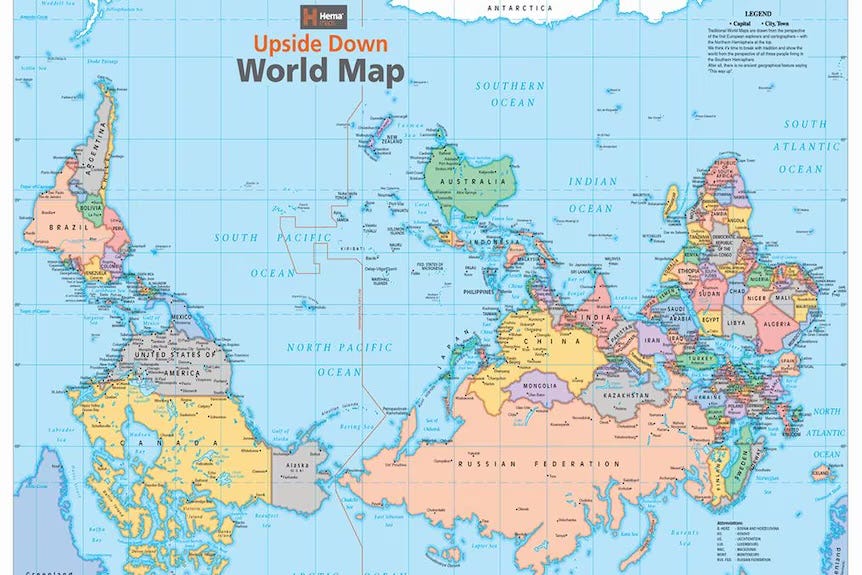
Sunday morning I was sitting with my dad waiting for Face the Nation to come on. It’s one of those small rituals that carried on. Something I used to watch with both my parents every Sunday morning and now watch with just him. Before the show started there was a segment on CBS Sunday Morning about upside down maps. Not metaphorical upside down maps. Literal ones. Maps where south is on top instead of north.
Apparently people have surprisingly strong reactions to them. Genuine discomfort. Disorientation. Because most of us grew up unconsciously absorbing the idea that north is “up” and south is “down,” even though in space there is no actual up or down. North being on top was never objective truth. It was a design choice that over time stopped looking like a design choice and started looking like reality itself.
There is something unsettling about that.
“You look back down at this blue sphere, and you see a world with no borders. You see a tiny mote of dust suspended in a sunbeam.”
— Natalie Batalha
One of the things I remember about being a boy is laying in the grass staring at the sky trying to understand blue. Trying to see how far I could actually see into it. Wondering about God. Wondering what was at the end of the universe and what was on the other side of that end. I remember the strange panic and awe of realizing infinity made no sense to me. Because if the universe ended, what did it end into? But if it didn’t end, how was that possible either?
I think in some ways I’ve been asking the same questions my entire life.
A while back I watched Brian Cox on The Late Show with Stephen Colbert showing an image from deep space containing ten thousand galaxies packed into a tiny black square of the universe. Ten thousand galaxies. Each containing billions of stars. Entire worlds and distances almost impossible for the human mind to meaningfully comprehend. At one point he asked, “What does it mean to live a finite fragile life in an infinite eternal universe?”
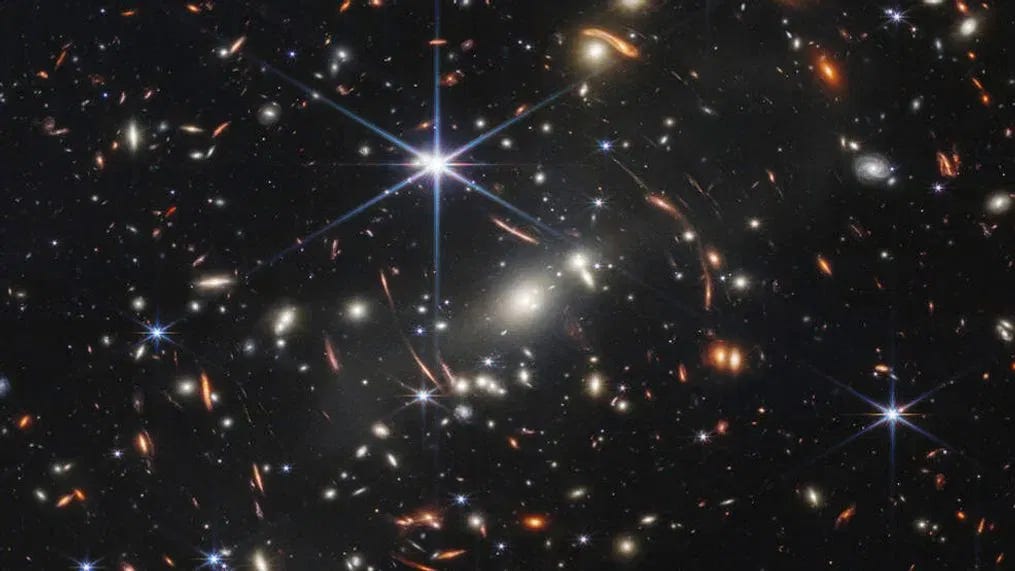
I remember sitting with that question for a long time afterward. The strange contradiction of being both microscopic and immense at the same time. Fragile and temporary while somehow containing an entire world of feeling and memory inside a single human life.
A human life can feel unbearably important and cosmically insignificant at the exact same time.
It reminds me of something I read years ago in Stephen Harrod Buhner’s book The Secret Teachings of Plants, which became one of those books that altered the way I see the living world. Not The Secret Life of Plants, the wildly popular seventies New Age book people sometimes confuse it with. Buhner’s work feels different to me. Wilder. More grounded. Less interested in mystical spectacle and more interested in relationship, participation, and perception. His writing carries this underlying assumption that human beings are not standing outside the living world objectively observing it, but are inside it, entangled with it.
Somewhere in the book he talks about coastlines and the strange problem of measuring them. And what fascinates me about it is that it exposes something deeper about human beings and our obsession with measurement itself. Euclidean geometry gave us agreed upon ways to map and measure the world. Straight lines. Fixed distances. It helped humans organize reality into something navigable and stable. We like certainty. We like things that can be quantified. Miles. Hours. Years. Distances between points. Measurable outcomes. We built entire civilizations around the assumption that reality can be cleanly mapped.
But lived experience constantly violates those clean measurements.
“For small creatures such as we, the vastness is bearable only through love.”
— Carl Sagan
A mile when you’re in love is different than walking a mile carrying grief. An hour in a hospital waiting room is different than an hour laughing with friends. Years caregiving is different than years spent trying to become yourself. The clock says they are equal. Human experience says otherwise.
Because from far away a coastline looks smooth and simple. But the closer you get, the more complexity appears. Tiny inlets. Rocks. Cracks. Curves within curves. The smaller the unit of measurement, the longer the shoreline becomes. An ant experiences a shoreline differently than a human walking it and differently than someone measuring it from an airplane.
And I wonder if time works the same way.
Because sometimes a single afternoon can feel endless. Five minutes can stretch so wide they barely seem survivable. But then somehow entire years vanish.
Somewhere along the way life becomes administrative. Bills. Passwords. Grocery stores. Medications. Appointments. You stop inhabiting moments. Days become to-dos to manage and check off instead of places you actually live.
And maybe that’s part of why time speeds up.
Not because life is objectively shorter or longer than we imagined, but because we’ve stopped paying attention to the details. Stopped being astonished by the ordinary. A year viewed from a distance collapses into almost nothing. But lived up close, a year contains thousands of tiny universes.
After a while days start blurring together. Routine has a way of sanding the edges off time. And then grief does the opposite. Grief suddenly slows everything back down again whether you want it to or not. It forces attention. You notice dust in the air. A plant that needs watered. A sigh from my dad that tells me he’s thinking about mom. You start noticing all the places someone used to be.
Maybe that’s why huge skies affect people the way they do. Montana. The desert. The ocean. Standing somewhere immense recalibrates the scale of your thoughts. Your problems stop feeling like the entire horizon.
Everything changes depending on distance. A mountain range. A shoreline. A lifetime. A grief.
Maybe the closer you look, the longer life becomes.
Because life is short.
And life is long.
Depending.
All are welcome here, but if you’re in a place to offer support, a paid subscription ($5/month or $50/year) is deeply appreciated. It’s not required, but it helps me keep showing up, to write, to share, to keep this thread of connection alive.
Out here in the countryside, caring for my folks is deeply meaningful, but often lonely. Writing about my experience and sharing it with you helps me stay grounded, inspired, and not quite so alone. Think of a paid subscription as a tip jar for the kind of storytelling that makes space for truth, tenderness, and the beautiful mess of being human.
Love this on many levels⏳